
What Should a Nonprofit Expect to Pay an Executive Search Firm?

You know you need help finding your next executive director. What you do not know is what that help is going to cost — or whether the number a search firm quotes you is fair.
Executive search pricing can feel like a black box. Boards get quotes ranging from a few thousand dollars to well over six figures, with fee structures that do not always make sense on first read. That uncertainty leads to one of two outcomes: nonprofits overpay for a search that does not fit their needs, or they skip professional search altogether and end up making a costly hire on their own.

Here is what nonprofit boards and hiring committees should actually expect to pay — and what drives that number up or down.
Most Firms Price Off a Percentage of Compensation
The industry standard is a percentage of the new hire's first-year total compensation — typically 20% to 33%.
That means a search for an executive director with a $120,000 salary could run anywhere from $24,000 to $40,000 in fees, before factoring in advertising, travel, background checks, or assessments. For larger organizations hiring at the CEO or C-suite level, that same percentage applied to a $200,000+ package pushes the fee well past $50,000.
This structure works well for the search firm. It does not always work well for the nonprofit — especially smaller and mid-sized organizations where every dollar is already stretched across programs and payroll.
Retained vs. Contingency Search: Know Which One You Are Buying
Not all search fees are created equal.
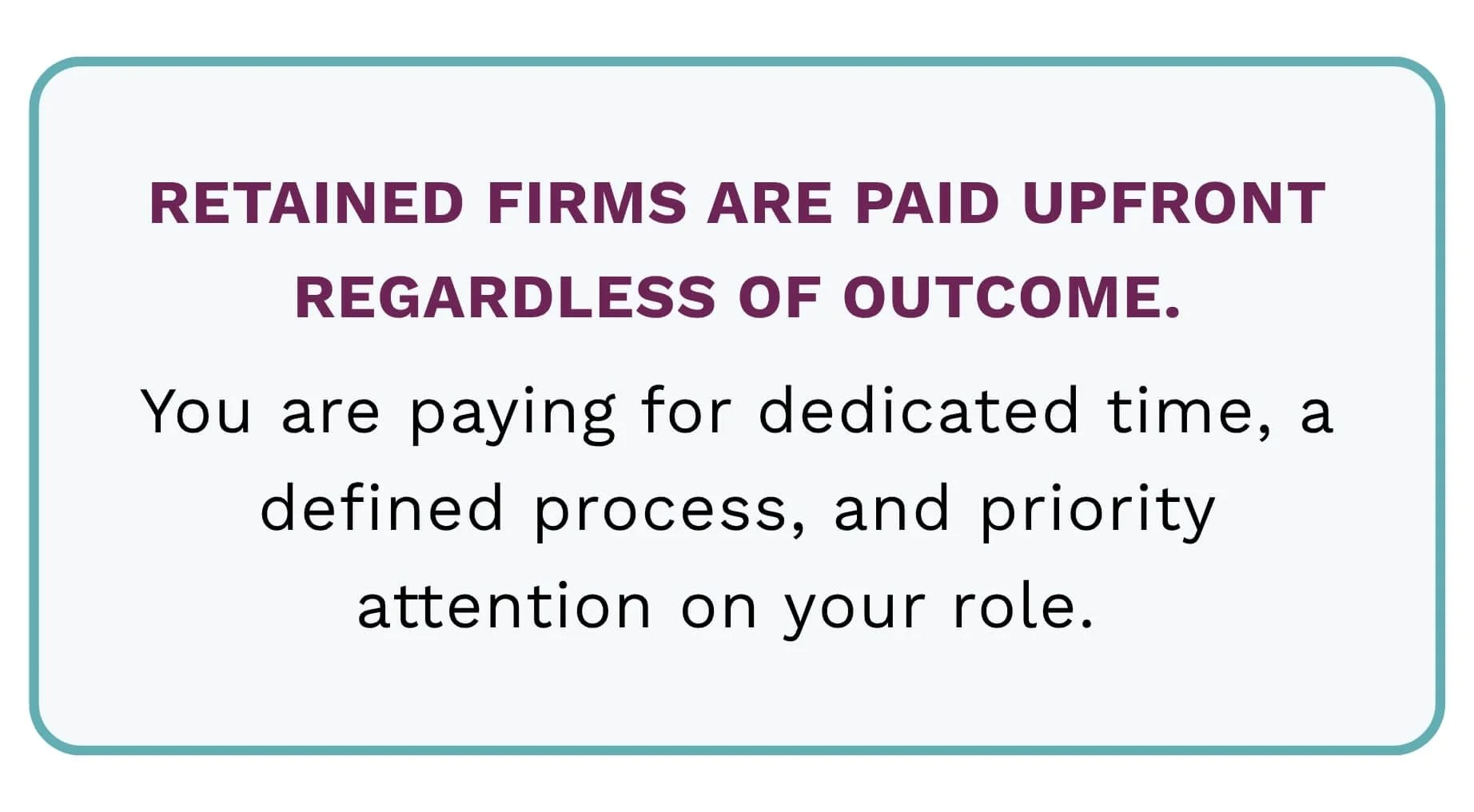
Retained firms are paid upfront — usually in thirds, billed at the start, midpoint, and completion of the search — regardless of outcome. You are paying for dedicated time, a defined process, and priority attention on your role. This is the model most large, national search firms use, and it is built for high-stakes executive placements.
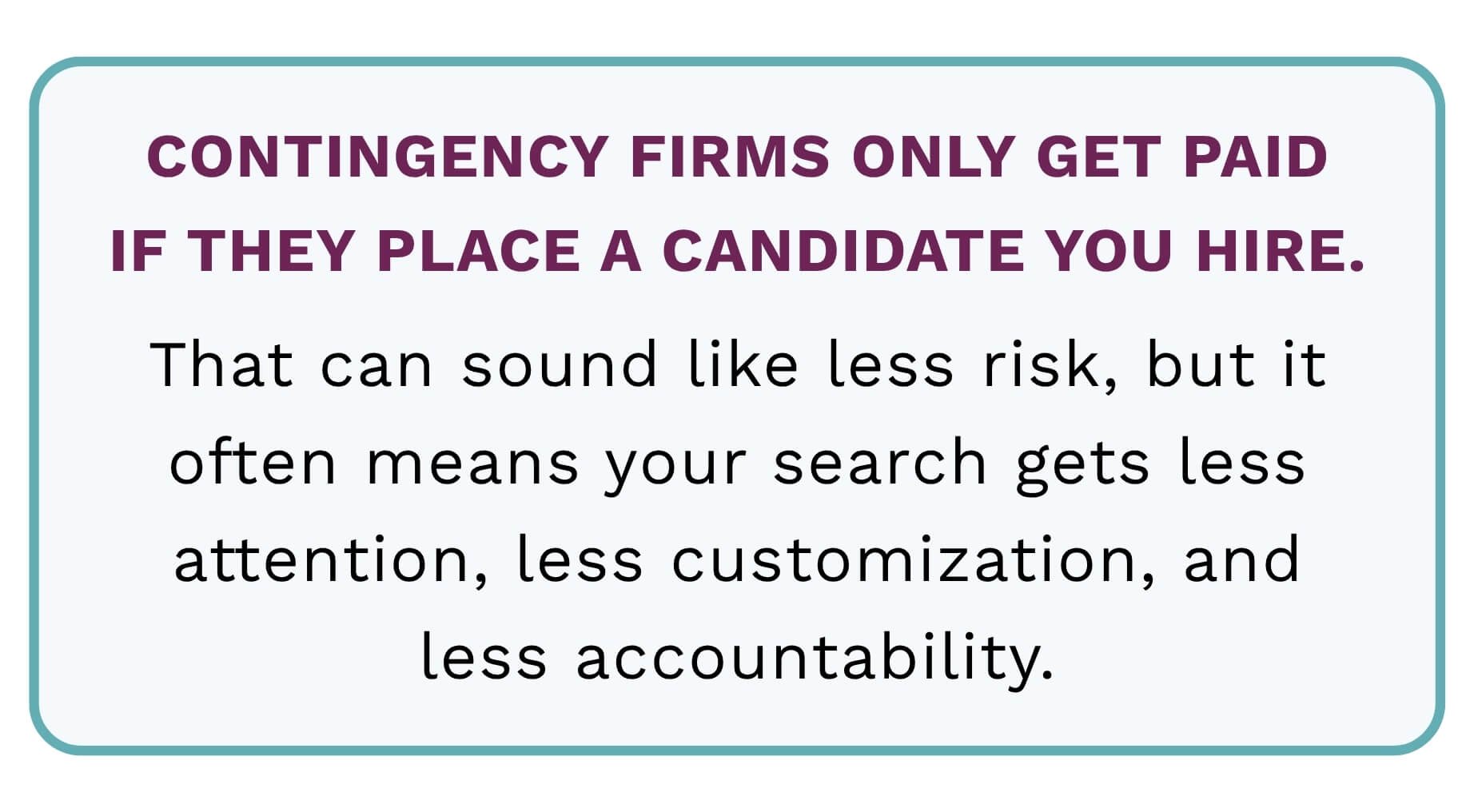
Contingency firms, by contrast, only get paid if they place a candidate you hire. That can sound like less risk, but it often means your search gets less attention, less customization, and less accountability — since the firm is juggling multiple searches at once and prioritizing whichever one closes fastest.
Neither model is inherently better. But a board that does not ask which one it is signing up for can end up disappointed by the process, the candidate pool, or both.
Flat-Fee and Sector-Specific Models Are Changing the Math
A growing number of nonprofit-focused search partners price differently than traditional retained firms.
Instead of a percentage tied to salary, some organizations charge a flat project fee based on the complexity of the search — not the size of the paycheck at the end of it. This matters because a percentage-of-salary model can unintentionally penalize nonprofits for paying their leaders fairly, while a flat fee keeps the cost predictable no matter what the final offer looks like.
Sector-specific search partners also tend to bring something general recruiters cannot: an existing network of nonprofit leaders, a realistic read on nonprofit salary bands, and an understanding of mission fit that goes beyond a resume. That expertise often shortens the search and reduces the risk of a mis-hire — which is its own form of savings.
The Real Cost Is Not Just the Invoice
A cheap search that ends in a bad hire is never actually cheap.
Boards should weigh the fee against what a failed executive placement costs: lost productivity, staff turnover, disrupted programs, and the expense of running the search all over again in twelve to eighteen months. The cost of a poor executive hire — once you account for severance, lost momentum, and the time it takes to recruit a replacement — consistently runs to multiples of that person's annual salary.
Viewed that way, the question is not simply what does this search cost. It is what is the risk of getting this hire wrong, and how much is a rigorous, sector-informed process worth to reduce that risk.
Questions to Ask Before You Sign
A clear, upfront conversation about cost will tell you a great deal about how a firm operates. Before engaging any search partner, ask:
Is this a flat fee or a percentage of compensation?
What is included — advertising, assessments, background checks, travel?
What happens if the hire does not work out within the first year?
What is the firm's specific experience placing nonprofit leaders, not just executives in general?
How is the fee structured over time, and what triggers each payment?
A firm that answers these questions clearly, without hedging, is a good early signal of how they will handle the rest of the search.
Mission Edge Was Built for This
You do not have to choose between an unaffordable national firm and doing it alone.
Our executive search team works exclusively with mission-driven organizations, which means our pricing, our process, and our candidate networks are all built around nonprofit realities — not corporate compensation packages. We help boards find leaders who are the right fit for their mission, their budget, and their next chapter — without the sticker shock that keeps so many nonprofits from getting the support they need.