
Bookkeeper, Accountant, Controller, or CFO? A Nonprofit Guide

Nonprofit leaders often use the titles bookkeeper, accountant, controller, and CFO as if they were interchangeable. They aren't.
Each role represents a different level of nonprofit accounting expertise, financial responsibility, and strategic involvement, and hiring the wrong one for your organization's stage can leave real gaps in reporting and oversight.
The stakes are real. According to the Nonprofit Finance Fund's 2025 State of the Nonprofit Sector Survey, more than half of nonprofits surveyed have three months or less of cash on hand, and over a third ended 2024 with an operating deficit, the highest share in ten years of the survey. Whose responsibility is it to track this, identify causes/remedies and plan change?
This guide walks through what a bookkeeper, accountant, controller, and CFO each do, how organization size and grant complexity affect staffing needs, and how to tell when your nonprofit has outgrown its current setup.
Why Nonprofit Accounting Roles Are Often Misunderstood
The differences between these titles aren't really about job labels. They reflect increasing levels of:
Technical accounting expertise
Financial responsibility
Strategic decision-making
Organizational complexity
The right structure depends on your nonprofit's revenue, number and type of grants, programs, staff size, and overall financial complexity. There's no universal revenue threshold at which an organization suddenly "needs" a controller or a CFO. A small, complex organization can outgrow its finance team well before a larger, simpler one does.
The person entering transactions into your accounting system may not be the person who should prepare your financial statements, and the person preparing those statements may not be the one advising your board on long-term strategy. Matching the role to the work is central to sound nonprofit accounting.
The Nonprofit Bookkeeper: Managing Day-to-Day Transactions
A nonprofit bookkeeper handles the daily recording and organizing of financial transactions. Typical duties include:
Entering deposits, expenses, and credit card transactions
Reconciling bank and credit card accounts
Processing accounts payable and receivable
Maintaining the chart of accounts and vendor records
Coding transactions to programs or funds
Assisting with month-end close and basic financial reports
Bookkeepers are often a good fit for small or start-up nonprofits with simple operations, typically under $1 million in annual revenue, though size alone shouldn't drive the decision. They can work with individual donations and straightforward foundation or local grants, and they may record grant-related transactions. What a bookkeeper generally shouldn't be asked to do alone is interpret GAAP, manage grant compliance, lead an audit, or advise the board on financial strategy.
The Nonprofit Accountant: Turning Transactions Into Financial Insight
An accountant takes an organization's financial information beyond basic recordkeeping and focuses on accurate reporting, analysis, and internal controls. Typical duties include:
Managing month-end and year-end close
Preparing financial statements and journal entries
Recording restricted and unrestricted net assets
Accounting for grants and preparing grant financial reports
Reconciling payroll and reviewing accounts payable and receivable
Preparing audit schedules and supporting the annual audit
Assisting with budgeting, forecasting, and budget-to-actual review
Accountants tend to serve small to mid-size nonprofits, roughly $500,000 to $10 million in annual revenue depending heavily on complexity. They can typically handle foundation, corporate, and government grants, including those with restricted budgets and reporting requirements, and for organizations with government or federal awards, they help monitor the specific compliance requirements tied to that funding.

The Nonprofit Controller: Safeguarding Accounting Integrity
A controller oversees the integrity of the accounting function and the financial reporting process as a whole, acting as the person who keeps the organization's accounting engine running properly. Typical duties include:
Overseeing the accounting department and month-end close
Establishing accounting policies, procedures, and internal controls
Supervising accountants and bookkeepers
Reviewing grant accounting and indirect cost allocations
Coordinating annual audits and working with external auditors
Ensuring GAAP compliance and accurate reporting to management and the board
Controllers are typically needed at mid-size nonprofits with multiple accounting staff, complex programs, or significant government funding, often in the range of $5 million to $50 million in annual revenue, though this varies widely. Organizations with multiple grants, cost-reimbursement contracts, or several funding sources with different reporting requirements are more likely to need controller-level oversight.
The Nonprofit CFO: Strategic Financial Leadership
A CFO operates at the executive and strategic level. The CFO helps leadership understand what happened, why, what's likely to happen next, and what the organization should do about it. Typical duties include:
Developing long-term financial strategy and forecasts
Managing cash flow, liquidity, and reserves
Advising the executive director, CEO, board, and finance committee
Evaluating new programs, funding opportunities, and financial risk
Overseeing banking relationships, investments, and financing decisions
Leading financial systems strategy and overseeing the controller and finance team
CFOs are most common at large or complex nonprofits, often $10 million or more in annual revenue, though a $5 million organization with highly complex operations may need CFO-level leadership while a $20 million organization with simple operations may not.
Comparing Nonprofit Accounting Roles at a Glance
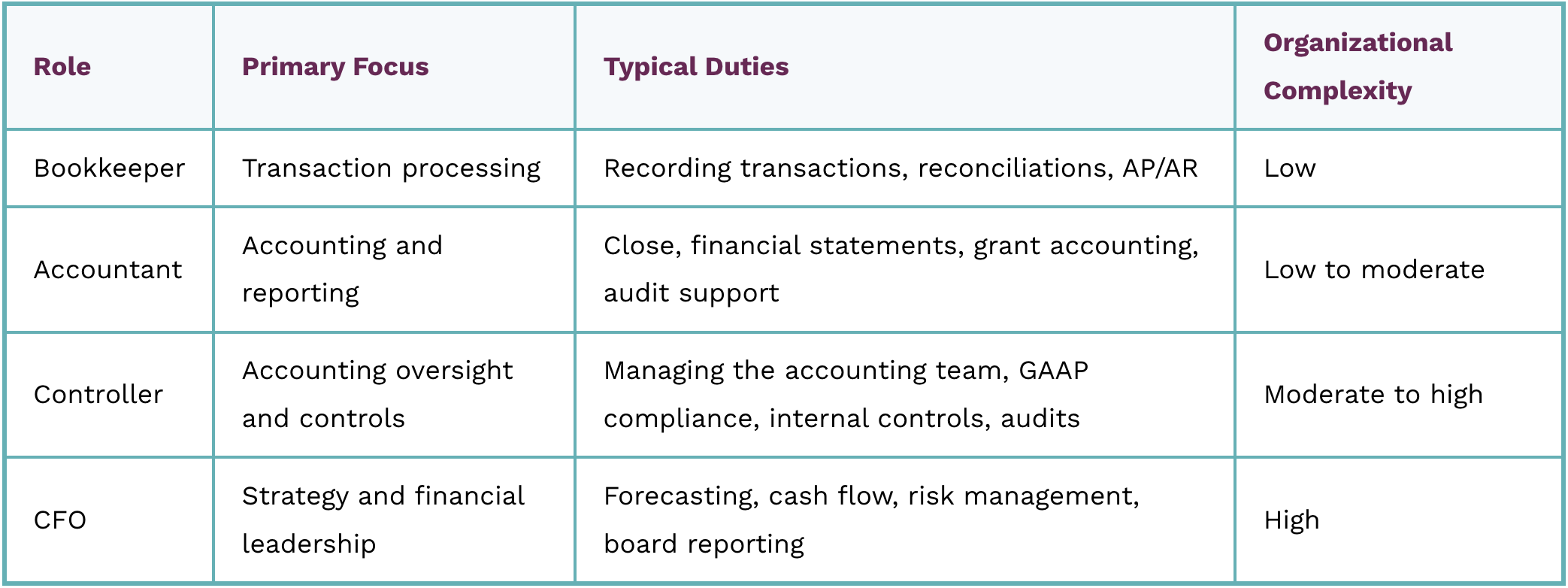
What Size Nonprofit Needs Which Nonprofit Accounting Role?
These are general guidelines, not fixed rules. Complexity often matters as much as revenue.
Under $1 million: A part-time bookkeeper and an outsourced accountant, with the executive director overseeing finances directly.
$1 million to $5 million: A bookkeeper plus an accountant or outsourced accounting team, often paired with a finance director or fractional controller.
$5 million to $15 million: Accounting staff and an accountant, led by a controller or director of finance, sometimes supported by a fractional CFO.
$15 million to $50 million: A full accounting team led by a controller, with a finance director or CFO providing strategic direction.
$50 million and above: A CFO overseeing a controller, an accounting team, and grants management and financial planning staff.
A $3 million nonprofit managing many complex grants can carry more financial complexity than a $10 million nonprofit funded mostly by individual donations. Grant volume and reporting requirements often drive staffing needs more than revenue alone.

Nonprofits that don't need or can't yet afford a full-time controller or CFO can still access that level of nonprofit accounting expertise through an outsourced or fractional model.
Mission Edge's nonprofit accounting services are built around this approach, scaling from bookkeeping support to controller and fractional CFO-level guidance as an organization grows.
Signs Your Nonprofit Has Outgrown Its Current Finance Structure
Consider a change in your finance structure if you notice several of the following:
The executive director is doing all the financial analysis
The board receives financial statements but doesn't understand them
Financial reports are consistently late or unavailable
Cash flow is managed by checking the bank balance
Grant restrictions aren't clearly tracked
Staff can't easily determine how much unrestricted cash is available
Audits are consistently stressful
Nobody is responsible for forecasting or financial modeling
If several of these sound familiar, it may be time to revisit how your accounting function is structured. Mission Edge's related post on why accurate accounting is critical for small nonprofit organizations covers the risks of falling behind on financial oversight in more detail.
Common Questions About Nonprofit Accounting Roles
📊 Does my nonprofit need a full-time CFO?
Not necessarily. Many nonprofits access CFO-level expertise through a fractional or outsourced CFO who provides budgeting, forecasting, and strategic guidance on a part-time basis, without the cost of a full-time executive hire.
📊 What's the real difference between a bookkeeper and an accountant?
A bookkeeper records and organizes transactions. An accountant interprets those transactions, applies GAAP and grant compliance rules, and produces financial statements leadership and funders can rely on.
📊 Can one outsourced team cover more than one of these roles?
Yes. An outsourced nonprofit accounting provider can combine bookkeeping, accounting, and controller-level oversight, and add fractional CFO support as needed, without requiring separate full-time hires for each function.
📊 Should staffing decisions be based on revenue alone?
No. Grant volume, the number of funding sources, and reporting complexity often matter more than total revenue when determining what level of nonprofit accounting support an organization needs.
Key Takeaways: Building the Right Nonprofit Accounting Team
Bookkeeper, accountant, controller, and CFO represent increasing levels of expertise and strategic responsibility, not just different job titles.
Grant complexity and reporting requirements often drive staffing needs more than revenue size.
Most nonprofits don't need every role filled internally. Outsourced and fractional models can provide the right level of nonprofit accounting expertise at each stage of growth.
Recognizing the warning signs of an outgrown finance structure early helps protect reporting accuracy, funder confidence, and board decision-making.

Building the right financial structure isn't about assembling the biggest finance department possible.
It's about matching nonprofit accounting expertise to your organization's size, grant complexity, and strategic goals.