When Should a Nonprofit Outsource Accounting? 6 Signs

Many nonprofit leaders assume there is a specific revenue level at which they should hand off their books to an outside team. In practice, the decision to outsource nonprofit accounting has less to do with a dollar figure and more to do with complexity, risk, and the expertise your organization actually needs. A small nonprofit juggling several restricted grants can face harder accounting questions than a larger one with a single, simple funding source.
A more useful test is whether your accounting needs, workload, internal-control risk, and required expertise have outgrown what one reasonably sized in-house position can provide. The signs below can help your board and leadership decide when outside support makes sense.
Why the Right Time Isn't About a Revenue Threshold
It is tempting to look for a clean rule, such as outsource once you pass a million dollars in revenue. That kind of universal threshold is hard to support with research. Two organizations with the same budget can have very different accounting demands depending on how many funding sources they manage, how many programs they run, and how much their reporting and compliance obligations have grown.

The better question is functional: can one in-house role realistically cover the accounting work, keep duties separated, and give leadership the reporting it needs?
When the answer is no, outsourcing becomes worth a serious look.
6 Signs It May Be Time to Outsource Your Nonprofit Accounting
1. You Need More Expertise Than One Hire Can Provide
A nonprofit often outgrows basic bookkeeping well before it has enough work to justify a full accounting department. As activity gets more complicated, you may need real depth in accrual accounting, restricted funds, grant tracking, budgeting, financial reporting, and audit preparation. Research from the Urban Institute has found that small nonprofits are at risk of devoting inadequate resources to accounting, which can weaken the quality of their financial reporting. Outsourcing gives you access to a broader range of skills without asking a single employee to be an expert in everything. Mission Edge covers this ground in its post on why accurate accounting is critical for small nonprofits.
2. One Person Has Too Much Control Over the Money
Segregation of duties is one of the strongest reasons to consider outside help. In a small office, the same person may enter transactions, approve payments, reconcile the bank account, and prepare reports, which removes the natural checks that catch errors and deter misuse. The U.S. Government Accountability Office notes that smaller entities face greater challenges separating duties because responsibilities are concentrated among fewer people, and it points to independent review and other compensating controls as ways to manage that risk. The stakes are real. The Association of Certified Fraud Examiners reports that a lack of internal controls was the single most common weakness behind occupational fraud in its 2025 study. An outside team can supply the independent review a small staff cannot.
3. Your Board Needs Reliable Nonprofit Accounting, Not Just Bookkeeping
Accounting should support the board's oversight role, not simply record what happened. Independent Sector's Principles for Good Governance and Ethical Practice calls for complete, current, and accurate financial records, strong controls, and timely reports for the board. The IRS also requires exempt organizations to keep books and records that support their income, expenses, and other reported activity. If your leadership needs meaningful monthly statements, budget-to-actual analysis, or cash-flow insight, the accounting function has to deliver more than transaction processing.
4. You're Growing or Adding Financial Complexity
Growth in programs, grants, staff, funding sources, or locations changes what your accounting has to do. New grants can require more detailed tracking, added restricted funds complicate reporting, and rising transaction volume makes manual processes impractical. Outsourcing lets the accounting function scale with the organization without repeatedly hiring, training, and restructuring an internal finance team. Mission Edge's nonprofit accounting services are built to scale this way for growing organizations.
5. The Cost of an Employee Isn't the Cost of an Accounting Function
A fair comparison is not simply an outsourced fee versus one salary. An in-house position also carries payroll taxes, benefits, paid time off, software, training, and backup coverage for when that person is out. Just as important, one employee usually brings the skills of one role, while an outsourced arrangement can offer several levels of expertise and extra capacity when you need it. That flexibility matters most when workload spikes during grant cycles, budgeting, year-end close, or audit season.
6. You're Preparing for an Audit, Major Grant, or Period of Rapid Growth
Outsourcing does not replace your responsibility for financial oversight, and it does not remove the need for an independent audit when one is required. It can, however, add capacity to set consistent procedures, reconcile accounts, tighten documentation, and prepare clean reports ahead of a big moment.
The IRS expects organizations to maintain records that support their financial activity and that may be requested during an examination, so strong systems built in advance make these milestones far less stressful.
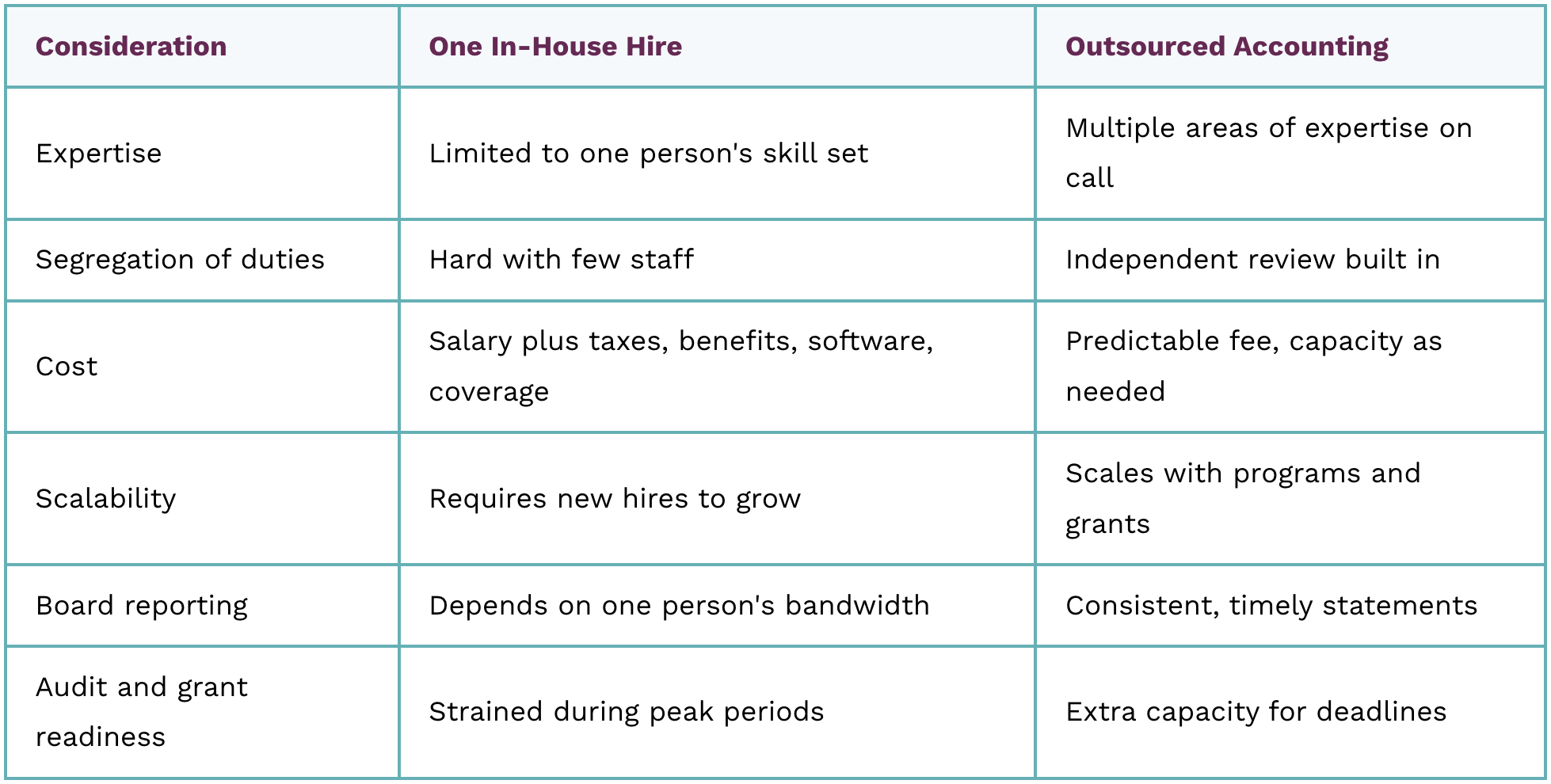
In-House vs. Outsourced Nonprofit Accounting at a Glance
The table below compares what a single in-house hire and an outsourced arrangement typically offer across the areas that matter most to a growing nonprofit.
Common Questions About Outsourcing Nonprofit Accounting
📊 Is there a revenue level where a nonprofit must outsource accounting?
No. There is no universal threshold. The decision depends on your organization's complexity, internal-control needs, expertise, workload, growth, and reporting requirements rather than a single dollar figure.
📊 Does outsourcing mean we no longer need an audit?
No. Outsourcing can improve audit readiness, but it does not replace an independent audit when one is required, and the board still holds responsibility for financial oversight.
📊 Can a very small nonprofit benefit from outsourcing?
Yes. Small teams often gain the most, because outsourcing supplies the separation of duties and independent review that a one- or two-person office cannot create on its own.
📊 Who is responsible for our finances if we outsource?
Your board and leadership remain responsible for oversight. Outsourcing provides the expertise, reporting, and controls that make that oversight easier to carry out.
Key Takeaways
There is no universal revenue threshold for outsourcing; complexity, risk, and expertise are the better tests.
Outsourcing helps when you need more expertise than one hire can provide, or when one person controls too much of the financial process.
It supports the board with timely, reliable reporting and the independent review that small teams struggle to build alone.
It scales with growth and adds capacity ahead of audits, major grants, and year-end close, without replacing the board's oversight duty.