
Leadership Transition Support Is Now Expected — And Here's Why That Matters

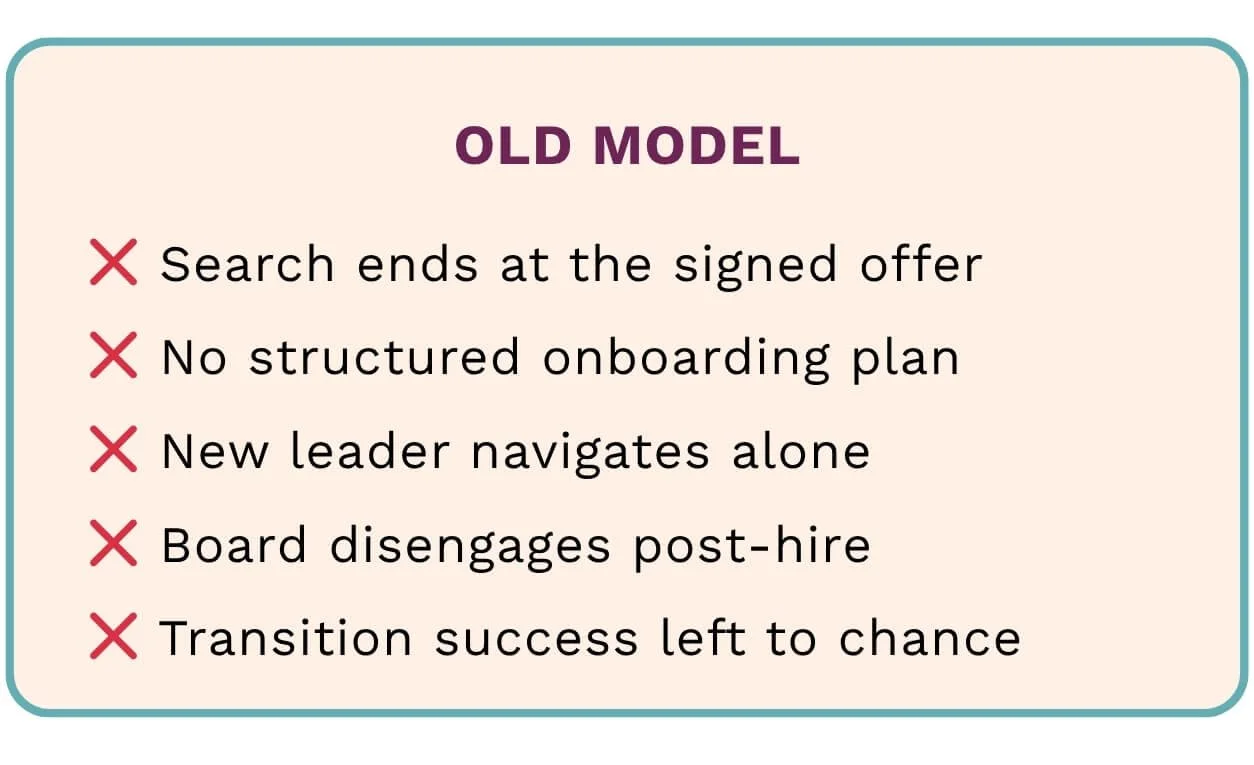
For years, the standard model for nonprofit executive search looked something like this: identify the role, launch the search, select the finalist, extend the offer, close the engagement. The search firm's job ended when the candidate signed on the dotted line.
That model is no longer enough — and nonprofit boards and organizations know it.
Across the sector, a clear and accelerating shift is underway. Boards and search committees increasingly want more than candidate placement. They want onboarding support. They want interim leadership guidance. They want transition planning that extends well beyond the hire date. And they want a search partner who understands that the most important work often begins after the offer is accepted.
This isn't a trend driven by high expectations alone. It's driven by what the data — and lived experience — keeps showing us: that a great hire can fail without the right support, and that the transition period is one of the most vulnerable and consequential windows in any organization's life.
Why the Old Nonprofit Executive Search Model Falls Short
The executive search process has traditionally been designed to optimize for one outcome: a signed offer letter. And while finding the right candidate is absolutely critical, it's only half the equation.
What happens in the weeks and months after a new leader arrives often determines whether the hire succeeds or struggles.
A new executive inherits a complex ecosystem — existing staff dynamics, board relationships, donor expectations, cultural norms, strategic commitments, and institutional history that may span decades. Without intentional support and structured onboarding, even the most talented leader can find themselves navigating that complexity alone, without adequate context, and without a clear runway for building the trust and credibility they need to lead effectively.

The transition into a new leadership role almost always has unexpected surprises and stress for the new executive.
Organizations and their new executives are so ready to hit the ground running that they overlook the importance of additional consulting support during this critical transition period.
The result, too often, is an executive who is technically in the role but not yet truly embedded in it — and an organization that has invested enormously in a search, only to underinvest in the moment that determines whether it pays off.
What Has Changed — And Why Now
Several forces have converged to make leadership transition support not just valuable but expected.
The volume of transitions is unprecedented. The nonprofit sector is in the midst of a generational leadership wave. Decades of long-tenured executives are retiring simultaneously, creating a level of concurrent transition that the sector has rarely experienced. For organizations navigating this, the stakes of each transition are high — and the margin for error is thin.
Boards are more sophisticated. More boards now understand their role in the successful transitions and onboarding of new CEOs. Boards are taking strategic approaches to transitions, including transition planning and onboarding support for new leaders — understanding that organizations are ecosystems where one change at the leadership level causes ripple effects throughout the entire organization.
The cost of a failed transition is well understood. Organizational leaders have seen — or experienced — what happens when a leadership transition goes poorly. Programs stall, staff leave, funders pull back, and the organization spends years recovering momentum it lost in a matter of months. That awareness has raised the urgency around getting the transition right, not just the search.
Research has validated what practitioners have long known. Organizations that invest in trust-building and governance alignment early in a new leader's tenure are better positioned for long-term stability, mission continuity, and philanthropic success. The data is no longer anecdotal — it's documented.
What Comprehensive Leadership Transition Support Looks Like

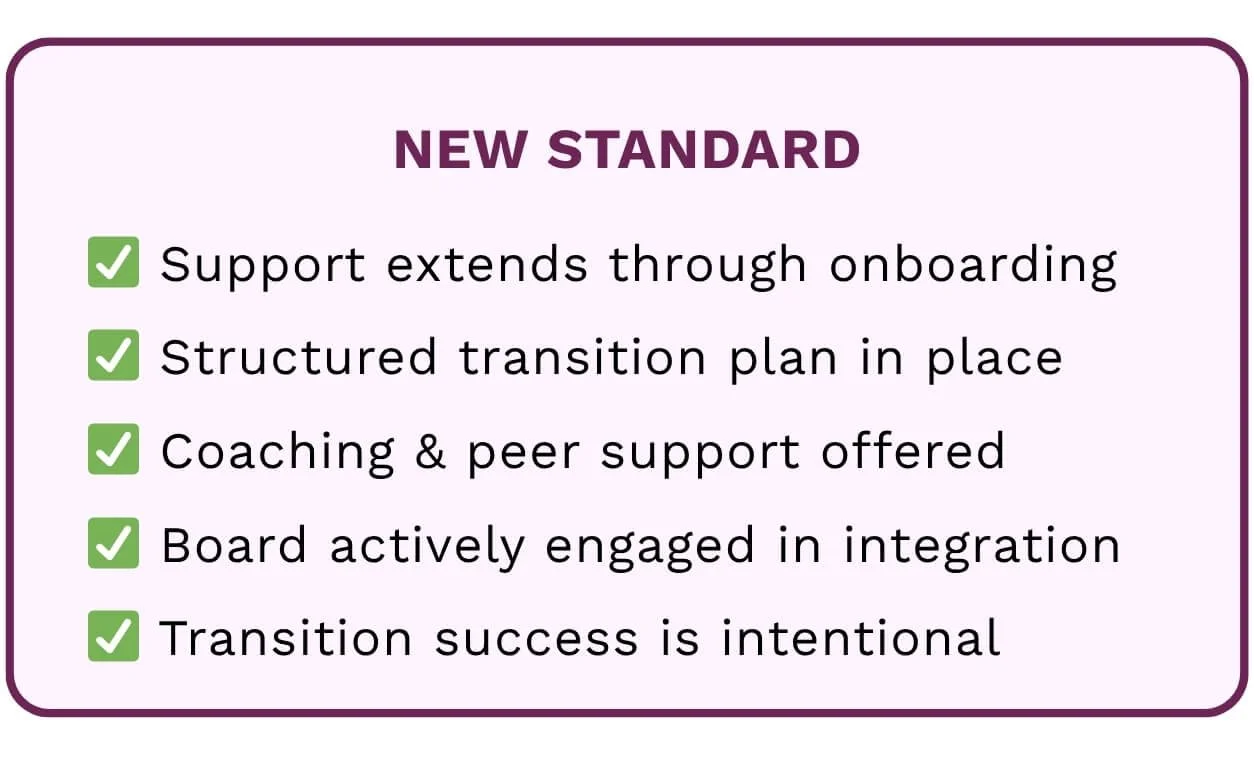
Transition support is not a single service — it's a continuum of intentional investments that span before, during, and after the executive search.
Here's what best practice looks like at each stage:
Before the Search: Transition Readiness
The groundwork for a successful transition begins long before a new leader is identified. This phase includes an honest organizational assessment — understanding the current state of culture, finances, board dynamics, and staff capacity — so that the search is informed by where the organization actually is, not just where it aspires to be.
It also means clarifying what the organization truly needs in its next leader. The skills that drove success under the previous executive may not be the same skills needed for the next chapter. The onboarding process can make or break a new executive's transition — investing time in properly equipping the new leader with the tools, information, and support they need to succeed is essential from the very start.
During the Transition: Interim Leadership
When a leader departs before a successor is in place, organizations face a critical choice. Moving too quickly to fill the role risks a poor hire. Moving too slowly risks organizational drift, staff anxiety, and funder concern.
Interim leadership can provide stability during a transition. When done well, it can achieve a specific goal during a time of inherent instability and provide the time needed for a thorough search — often six or more months for top leadership roles. A skilled interim leader can also do something the permanent search cannot: stabilize the organization, surface important information about culture and operational health, and prepare the ground for the incoming executive to arrive with clarity rather than chaos.
After the Hire: Onboarding and Integration
This is where transition support is most often underinvested — and where its absence is most consequential.
Structured onboarding for a nonprofit executive goes far beyond a first-week orientation.
It includes a full handover of institutional knowledge from the outgoing leader, introductions to key donors, funders, and community partners, access to strategic documents and financial history, and facilitated conversations between the new executive and the board that establish clear expectations and working norms.
Creating two distinct committees — a Search Committee to lead recruitment and selection, and a Transition Committee to support onboarding and strategic continuity — ensures that the work of getting the new leader embedded doesn't get lost once the search is closed.
Coaching and peer support for the new executive also matters more than most organizations realize.
The new executive makes up one leg of what can be described as a three-legged stool — with the board and staff making up the other two. It can be isolating. Having a safe space to share ideas, discuss challenges, and process the early months of leadership can make a measurable difference in both the executive's effectiveness and their retention.
The Board's Responsibility in Transition
Leadership transition support is not solely the responsibility of a search firm or an HR consultant. It is, at its core, a board governance responsibility.
Raising and allocating funds to support the leader's first year — and being honest with candidates about the organization's current financial and reputational state, as well as internal dynamics and culture — are essential board commitments. Boards that withhold that transparency in order to attract a candidate are setting that candidate up to fail.
The board's role in transition doesn't end when the new executive walks through the door. It extends through the first year — introducing the new leader to the community, establishing clear governance boundaries, and actively building the trust and communication patterns that will define the board-executive relationship for years to come.
What This Means for How You Choose a Nonprofit Search Partner
If your organization is preparing for an executive search, the question to ask potential search partners is no longer just "How do you find candidates?" It's "How do you support the transition?"
A search firm that closes its engagement at the offer letter is leaving your organization — and your new executive — to navigate the most critical phase alone. The best search partners today are building transition support into their engagements as a matter of standard practice, not as an add-on service.
At Mission Edge, we understand that executive search and leadership transition are two phases of the same commitment. Our work with nonprofit organizations doesn't end when a candidate is placed — it extends through the onboarding process, the first 90 days, and beyond, because we know that the search is only successful when the leader is genuinely thriving in the role.
The Signed Offer Letter Is Not the Finish Line
It's the starting line.
Nonprofit organizations that invest in leadership transition support — before, during, and after the search — protect their investment, reduce the risk of a failed transition, and give their new executive the best possible chance to lead with confidence, credibility, and impact from day one.
The sector has learned this lesson the hard way, and the shift in expectations reflects that hard-won wisdom. Boards that understand this are building organizations that don't just survive leadership change — they grow through it.

Planning a leadership transition?
Contact Mission Edge today to learn how our executive search and transition support services can help your organization navigate this pivotal moment with intention and confidence.