
Nonprofit Leader: Is It Time to Rethink How You Hire at the Top?

When a senior leadership position opens up at your nonprofit — whether anticipated or not — the pressure to fill it quickly is immediate and real. Programs are waiting. Staff are uncertain. The board is watching. Funders are asking questions.
And in that pressure, organizations make one of two mistakes. The first is moving too fast — posting the role internally, reviewing applications as they come in, and extending an offer to the strongest candidate in the pool without asking whether the pool itself was strong enough. The second is moving too slowly — stalling on a decision about process, losing momentum, and arriving at a search months later without a clear strategy.
Both paths carry the same risk: ending up with the wrong person in a role where the cost of being wrong is enormous.

Hiring the right executive is one of the most consequential decisions a nonprofit will make.
It shapes your culture, your strategy, your team dynamics, and your ability to deliver on your mission.
It deserves a process as serious as the decision itself. For many organizations, that means asking an honest question: should we be running this search ourselves — or bringing in a partner who does this every day?
The Case for a Different Approach
Most nonprofits have experience hiring staff. Far fewer have experience conducting an executive search — and the difference matters more than most organizations realize.
An executive search is not a more senior version of a staff hire. The stakes are higher, the candidate pool is narrower, the evaluation criteria are more nuanced, and the margin for error is smaller. The skills and judgment required to assess whether a candidate has the right combination of mission alignment, leadership style, strategic vision, and cultural fit — at a senior level — are genuinely specialized. And the process required to find and engage those candidates, particularly those who aren't actively looking, is fundamentally different from posting a job and reviewing applications.
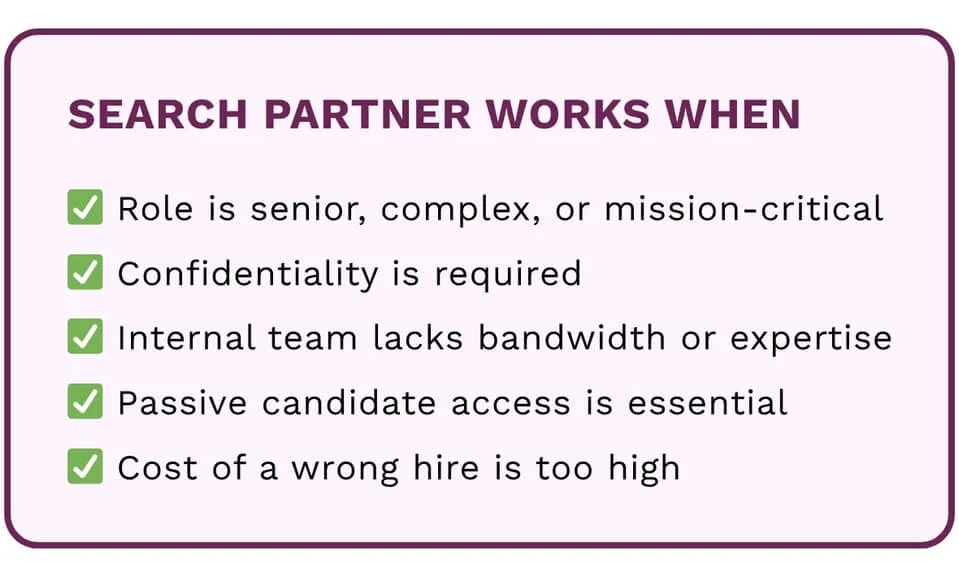
This is not an argument that every nonprofit needs an executive search firm for every leadership hire. There are situations where internal search processes work well. But there are also situations where the cost of getting it wrong is high enough — and the likelihood of getting it right without dedicated expertise is low enough — that the question of whether to bring in a partner deserves serious consideration.
When a Search Partner Adds Real Value
When the Best Candidates Aren't Looking for You
The most qualified candidates for a senior nonprofit leadership role are almost never the ones who find your job posting on a job board. They are currently employed, embedded in the sector, and not actively searching. They will only consider a move if someone they trust — someone who understands their goals, values, and career trajectory — reaches out with an opportunity that feels genuinely compelling.
This is what executive search firms do. They maintain broad, deep networks of sector-specific talent — including leaders from adjacent fields who bring relevant expertise — and they cultivate those relationships over time. The ability to access and engage that passive candidate pool is one of the most significant advantages a search partner brings, and it is simply not replicable through internal channels alone.
When the Risk of a Bad Hire Is Too High
The cost of a failed executive hire — in financial terms, cultural terms, and mission terms — is well documented. Replacement costs typically run between 50% and 200% of annual salary. The organizational disruption, staff turnover, and funder concern that accompany a leadership misstep can set an organization back years.
A structured, rigorous search process — with competency-based interviewing, multiple assessment touchpoints, thorough reference checks, and systematic evaluation of mission and culture alignment — significantly reduces that risk. Search firms develop and refine these processes across hundreds of engagements. They know what to look for, what to probe, and what warning signs to take seriously. That expertise is hard to replicate in an organization that conducts an executive search once every several years.
When Confidentiality Is Required
Leadership transitions can be delicate. If the organization is replacing a current executive who hasn't yet announced a departure, navigating a founder transition, or managing a situation where premature disclosure could damage staff morale or funder relationships, confidentiality is not optional — it's essential.
Running a confidential search internally is genuinely difficult, particularly in smaller organizations where everyone knows everyone. A search partner provides the structural separation needed to protect both the organization and the candidates under consideration, managing the process with discretion and professionalism from start to finish.
When Your Team Doesn't Have the Bandwidth
Executive searches are time-intensive. Sourcing candidates, managing outreach, scheduling and conducting interviews, coordinating with the board, running reference checks, negotiating offers — done properly, this work can consume hundreds of staff hours over the course of a three-to-six-month engagement.
For organizations where leadership is already stretched thin managing programs, fundraising, and operations, absorbing that workload internally often means the search receives less attention than it deserves — or that the rest of the organization receives less attention than it needs.

A dedicated search partner takes on the operational weight of the process, keeping it moving with discipline and professionalism while your team stays focused on running the organization.
When You Need More Than Resumes
One of the less obvious but significant contributions a search firm makes is market intelligence. What is the competitive compensation range for this role? What leadership structures are comparable organizations using? What are the most common reasons searches for this type of role fail? What does the current candidate market look like?
This information shapes better decisions — about how the role is defined, how it is positioned, what compensation will attract strong candidates, and how the offer is ultimately constructed. Organizations without access to current market data often design searches around internal expectations rather than external realities, and end up surprised when the candidates they want aren't interested in what they're offering.
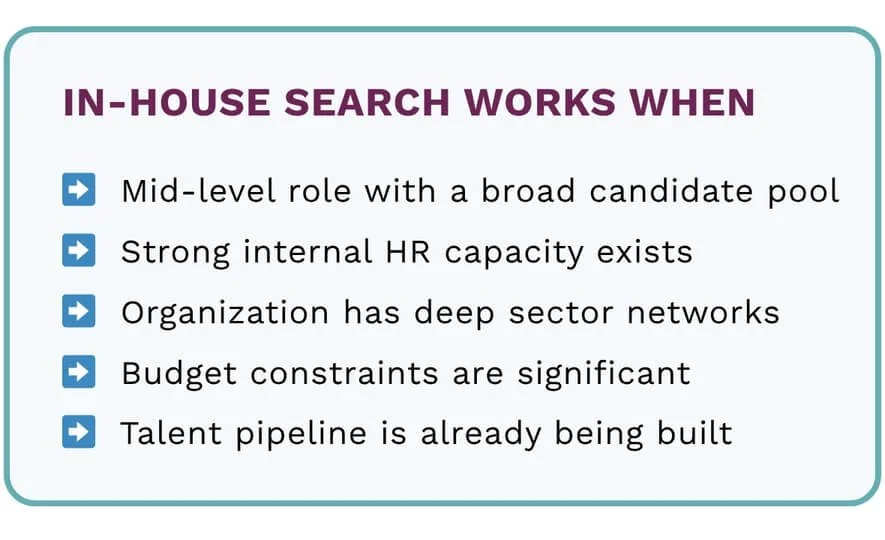
When an In-House Search Makes Sense: It's worth being honest that executive search partners aren't the right choice in every situation.
For mid-level management roles where the candidate pool is broader and the stakes, while real, are lower — an in-house search is often efficient and appropriate. For organizations with strong internal HR capacity and existing networks in their sector, some searches can be conducted effectively without external support. And for organizations with significant budget constraints, the investment in a search firm may not be feasible for every senior hire.
In many cases, the most effective approach is a hybrid:
An internal team that owns the process and the candidate relationships, supported by a search partner who provides structure, sourcing reach, and the expertise to evaluate candidates rigorously and honestly.
What the Right Nonprofit Search Partner Looks Like
If you decide to engage a search partner, the selection of that partner matters as much as the decision to engage one. Not all executive search firms understand nonprofit organizations, mission-driven culture, or the specific dynamics of a board-led search process.
Look for a firm with demonstrated experience in the nonprofit sector, a track record of successful placements in roles similar to yours, a clear process that includes candidate engagement rather than just candidate presentation, and a genuine commitment to equity and diversity in the search.
Good questions to ask:
How do they source candidates beyond their existing network?
What does their process looks like for evaluating mission and culture alignment?
What support do they provide after placement? Because as we've written about extensively, the search doesn't end at the offer letter.
The Bottom Line: The right executive hire can transform your organization's trajectory.
The wrong one can set it back years. That asymmetry is exactly why the process deserves more strategic attention than it typically receives.
Whether you run the search internally, engage a partner, or pursue a hybrid approach, the most important thing is that the decision is made deliberately — based on an honest assessment of your capacity, the complexity of the role, and the risk profile of getting it wrong.
At Mission Edge, we help nonprofits think holistically about executive leadership — from defining the role and evaluating process options to connecting organizations with trusted search partners who understand mission-driven work. We're here to help you navigate the decision and the process with confidence.

Planning a leadership transition?
See how Mission Edge can support you in making sure your next hire counts.