
What's the Difference Between Nonprofit Executive Search and Recruiting?

If you've ever sat in a board meeting trying to figure out how to fill a departing executive director's seat, you've probably heard both terms thrown around: executive search and recruiting. They sound similar. They both involve finding people for jobs. So what's the difference — and does it really matter which one you use?
For nonprofit leaders navigating a leadership transition, the answer is yes. It matters quite a lot. Understanding the distinction can mean the difference between a hire that transforms your organization and one that sets it back.
Here's your guide to understanding both — and knowing which one your nonprofit actually needs.
First, Let's Define the Terms: Recruiting vs. Executive Search
Recruiting
Sometimes called contingency recruiting or general staffing
This is the process of filling open positions by sourcing candidates from an available pool of active job seekers. Recruiters typically work across multiple clients simultaneously, posting job listings, screening applications, and presenting qualified candidates. It's largely a volume-driven process, and recruiters are often paid only when a placement is made.
Executive search
Sometimes called retained search
This is a fundamentally different engagement. It's a dedicated, consultative process designed specifically to identify and recruit senior leaders, often including candidates who are not actively looking for a new role. Executive search firms are typically retained by the client organization and work exclusively on that search until it is successfully completed.
Same goal, very different approach.
The Key Differences — Side by Side
1. Active vs. Passive Candidates
Recruiting largely targets active candidates — people who are already looking for a job, submitting applications, and available in public talent pools. This works well for many roles, but it has a significant limitation at the executive level: the best candidates are often not looking.

Executive search is built around finding and engaging passive candidates — accomplished leaders who are currently employed, not scanning job boards, and who would only consider a move for the right opportunity.
Reaching these individuals requires relationships, industry knowledge, and a compelling case for why your organization is worth their attention.
For nonprofit executive roles, this distinction is especially important. The most effective nonprofit CEOs and Executive Directors are often deeply embedded in the sector — they're not posting their resumes on Indeed.
2. Transactional vs. Consultative
A recruiting engagement is largely transactional: here is the job description, find us candidates who match. The recruiter's job is to move quickly and present options.
An executive search engagement is consultative from the start. A good executive search firm doesn't just take your job description and run — they help you examine it. They ask hard questions: Is this role defined correctly for where the organization is going? What leadership style does your culture actually need? What does success look like in year one versus year three? They help you think before they help you search.
For nonprofit boards that may not conduct executive searches frequently, this guidance is invaluable.
3. Speed vs. Thoroughness
Recruiting is optimized for speed. The goal is to fill the position as quickly as possible with a qualified candidate.
Executive search is optimized for fit. The process is more thorough — typically spanning four to six months — and includes deep candidate assessment, stakeholder interviews, reference checks, and deliberate evaluation of both competency and culture alignment. It moves with purpose, not urgency.
This isn't to say executive search is slow — it's that it is appropriately paced for decisions of this magnitude.
4. Breadth vs. Depth
Recruiters often manage dozens of open positions simultaneously. Their attention is divided by design, because their model depends on volume.
Executive search firms work on a limited number of searches at a time, with a dedicated team assigned to each engagement. Your search isn't one of fifty — it's one of a few, and it receives the focused attention that a leadership transition deserves.
5. The Relationship Model
Contingency recruiters are paid upon placement. This creates a financial incentive to close quickly, which doesn't always align with the organization's best interest.
Executive search firms are retained — meaning they are compensated for the quality and integrity of the process, not just the outcome. This structure allows them to take the time needed, be honest when a candidate isn't the right fit, and prioritize your organization's long-term success over a quick transaction.
Why This Matters Especially for Nonprofits:
Nonprofit organizations face a unique set of leadership challenges that make the executive search model particularly well-suited to their needs.
Mission alignment is non-negotiable. Nonprofit executives must be motivated by more than compensation — they need to believe in the work. Identifying candidates with genuine values alignment requires more than resume screening. It requires conversation, discernment, and sector knowledge.
Boards need guidance. Many nonprofit boards conduct an executive search infrequently — sometimes only once or twice in an organization's history. An executive search firm provides the process expertise that boards simply don't have in-house.
The stakes are high and the margins are thin. A failed executive hire in the nonprofit sector — as we've written about before — carries financial, cultural, and programmatic costs that most organizations can't easily absorb. Getting it right the first time isn't just preferable. For many nonprofits, it's essential.
Emphasize access and fairness in process. An effective search process is built with intention. Expanding access to leadership opportunities requires more than posting a role, it involves deliberate outreach, clear evaluation criteria, and a process designed to ensure candidates are considered thoughtfully and consistently. A dedicated executive search creates the conditions for a fair and thorough evaluation.
So Which One Does Your Nonprofit Need?
Here's a simple way to think about it:
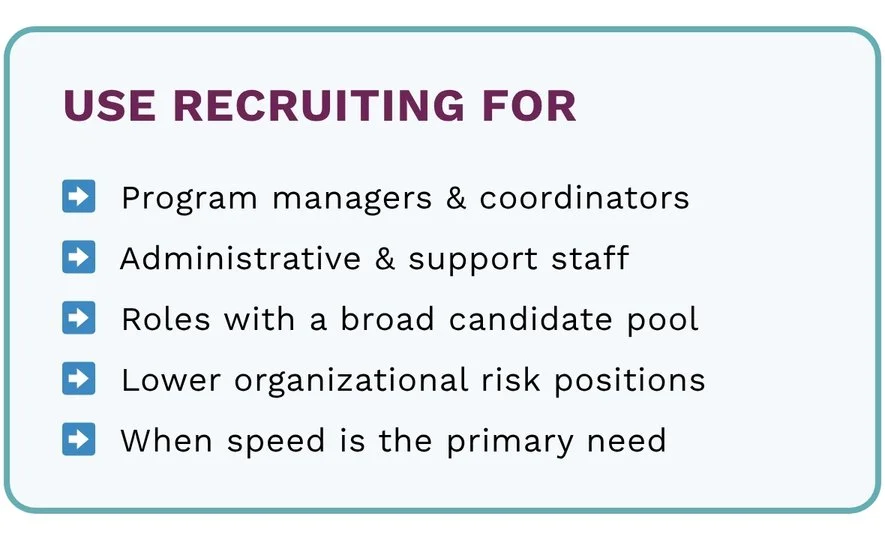
If you're filling a program manager, coordinator, or mid-level staff role — recruiting is likely the right tool.
It's efficient, cost-effective, and appropriate for roles where the candidate pool is broader and the organizational stakes are lower.
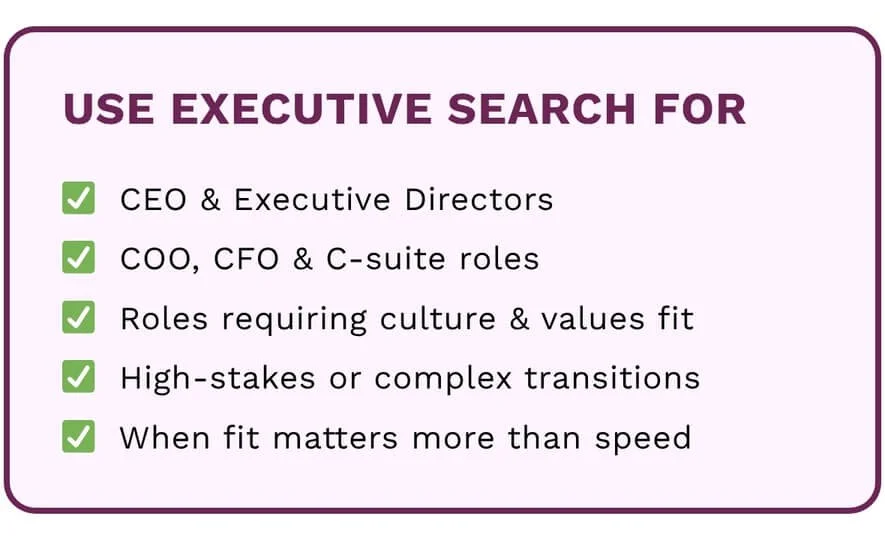
If you're filling a CEO, Executive Director, COO, CFO, or other senior leadership role — executive search is the right investment.
The complexity of the decision, the importance of fit, and the long-term impact on your organization warrant a more rigorous, dedicated process.
The question isn't whether you can afford an executive search. The question is whether you can afford not to have one.
How Mission Edge Approaches Executive Search
At Mission Edge, our executive search practice is built on a simple belief: nonprofit organizations deserve the same level of rigor and expertise in leadership hiring that the private sector takes for granted.
Our process is consultative, equity-centered, and designed specifically for mission-driven organizations. We partner with your board and leadership team from role definition through onboarding — because a great hire doesn't end with an accepted offer. It begins there.