New Workforce Norms & HR Infrastructure: What Nonprofits Need to Build Right Now
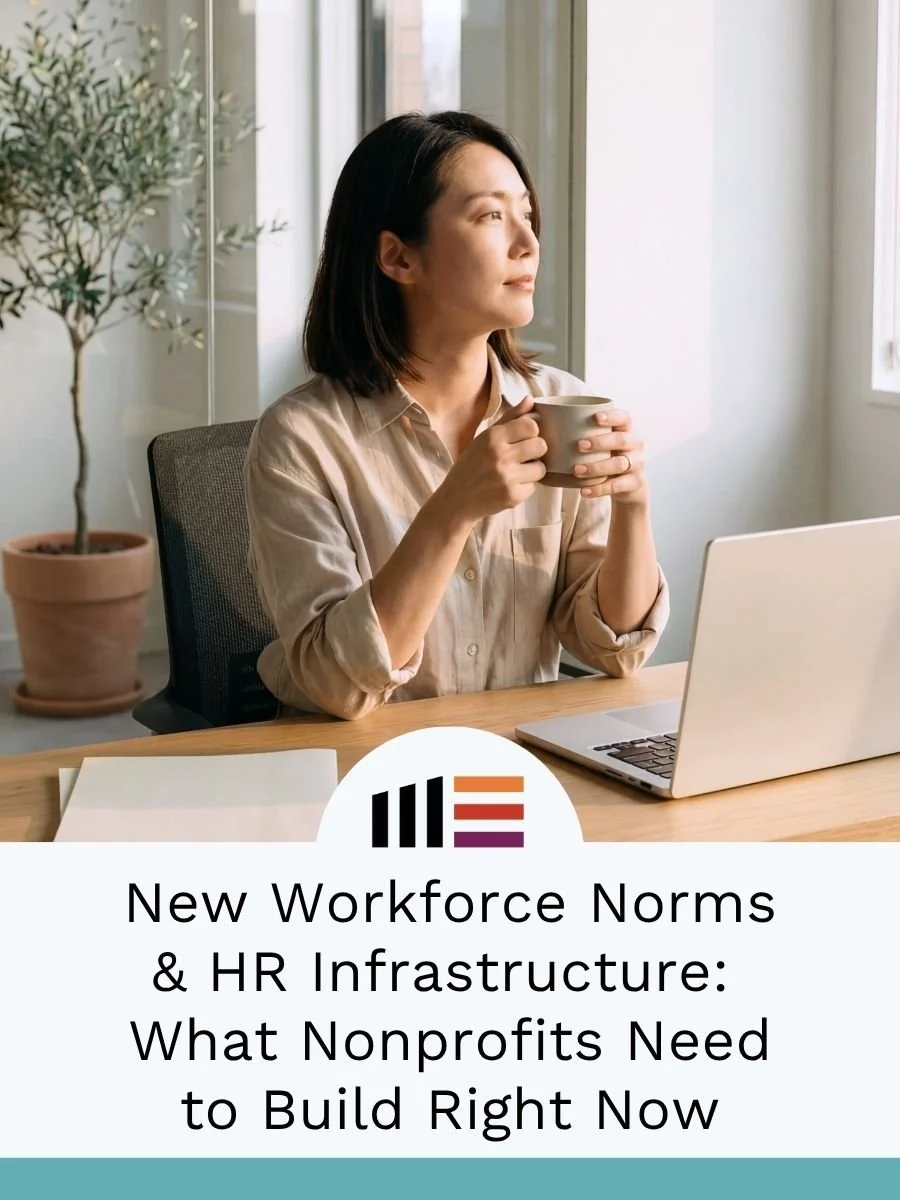
Nonprofit leaders are managing a workforce that looks, thinks, and works fundamentally differently than the one most of their HR systems were designed for.
The policies in the employee handbook may not have been updated since the last executive director. The performance review process still runs on an annual cycle that few managers have time to conduct well. The onboarding experience is inconsistent. And somewhere in the back of every leader's mind is the nagging awareness that the organization's internal practices don't quite match the values it projects externally.
This isn't negligence. It's the predictable result of a sector that has always asked its people to prioritize mission over infrastructure — and where the investment in HR systems has perpetually lagged behind the pace of change happening outside the organization's walls.
The workforce has changed. Staff expectations have changed. The legal landscape has changed.

The organizations that are struggling most with recruitment and retention right now are often the ones whose HR infrastructure hasn't kept up.
Understanding what has shifted — and what needs to be built in response — is one of the most strategic investments a nonprofit can make right now.
What Has Changed for Nonprofit Staff
Flexibility Is No Longer Negotiable — Even in Mission-Driven Work
For years, many nonprofits operated under an implicit understanding: staff would accept demanding, often in-person work because the mission made it worth it. That understanding has fundamentally eroded.
Hybrid and remote work options have become permanent employee expectations. Nonprofits that embrace flexibility are better positioned to attract and retain top talent, particularly among younger, mission-driven professionals who prioritize work-life balance. This creates a genuine tension for organizations where program delivery requires physical presence — and it's a tension that deserves honest, role-specific resolution rather than a blanket policy in either direction.
Many candidates, even at the leadership level, remain uninterested in relocation or full-time, in-office roles — and mismatched expectations on this front can quickly derail a hiring process. The answer isn't to abandon all in-person requirements. It's better to be deliberate and transparent about which roles genuinely require in-person work, which can flex, and how hybrid arrangements will be managed equitably across the organization.
Vague flexibility is worse than no flexibility. When some staff have informal remote arrangements while others don't, it creates resentment and inequity that undermines culture. A documented, role-specific, consistently applied approach to flexible work is the goal — and it requires building it into HR infrastructure, not just managing it informally.
The Four-Generation Nonprofit Workforce Requires Active Design
Nonprofit organizations today are managing staff across four generations simultaneously — Baby Boomers, Generation X, Millennials, and Generation Z — each with meaningfully different expectations, communication preferences, and definitions of a good employer.
Gen Z and Millennials are projected to make up 74% of the global workforce by 2030, with 89% of Gen Z saying a sense of purpose is essential to job satisfaction and well-being. For nonprofits, this is genuinely good news — the sector's mission is a natural attractor for purpose-driven talent. But mission alone is no longer sufficient. Gen Z candidates expect digital fluency, transparency, rapid feedback, and clear growth pathways alongside purpose. They are also the generation that most benefits from in-person mentorship and structured development — a nuance that gets lost when flexibility is treated as a simple binary.
Baby Boomers are rapidly reaching and surpassing retirement age, creating significant challenges around brain drain, leadership gaps, and the need for knowledge transfer through mentorship and cross-training. For nonprofit organizations where long-tenured staff carry critical community relationships and program history, this generational transition is not just an HR challenge — it is a mission continuity risk.
Managing this generational diversity well doesn't happen by accident.
It requires HR infrastructure that doesn't assume one size fits all: benefits that address varied life-stage needs, communication practices that work across different style preferences, career development pathways that are meaningful at every level, and managers who are equipped to lead people who think and work differently than they do.
Staff Are Watching What Leaders Do — Not Just What They Say
In the nonprofit sector, where burnout is chronic and organizational resources are limited, the relationship between leadership behavior and staff culture has never been more consequential. 90% of employees say they are stressed at work, with the biggest concerns including lack of career growth, limited flexibility, and worry over job stability.

Nonprofit staff, more than most, entered their roles with a genuine commitment to the work.
When they encounter leadership that models unsustainable hours, communicates inconsistently, or fails to acknowledge the emotional demands of mission-driven work, the resulting disillusionment is particularly acute.
The gap between an organization's stated values and its actual culture is something staff feel in their daily experience — and it is one of the most significant drivers of departure in the sector.
Professionals entering the nonprofit sector are demanding flexibility, equity, and professional growth alongside purpose-driven work. Organizations that fail to adapt risk losing qualified candidates to those that embrace a modern and inclusive approach. Adapting doesn't mean abandoning standards or structure. It means building an HR infrastructure that reflects the values the organization claims to hold.
What Nonprofit HR Infrastructure Needs to Include
Understanding the shifts is step one. The harder step is assessing honestly whether your organization's HR systems are built to operate within them — and building what's missing.
Documented Flexible Work Policies That Are Role-Specific and Equitable
If your organization doesn't have a written, current flexible work policy, you are managing flexibility informally — and informal flexibility defaults to inequity. It flows to whoever has the most access to decision-makers, and it leaves everyone else uncertain and resentful.
A strong flexible work policy for a nonprofit doesn't require that every role become hybrid. It requires clarity: which roles can flex, what in-person expectations look like for those that can't, how remote staff stay connected to culture and decision-making, and how flexibility is managed consistently across departments. That policy should be revisited at least annually — not filed and forgotten.
Performance Systems Built Around Outcomes, Not Presence
The traditional performance management model — annual reviews, competency ratings, and an implicit equation of visibility with productivity — was already inadequate before hybrid work made it untenable. In today's nonprofit environment, where staff may be working across different locations, schedules, and program contexts, performance evaluation must be anchored in outcomes: what was accomplished, what impact was created, how the team was supported.
This also means building in more frequent, lighter-touch check-ins that create accountability without micromanagement, and connecting individual goals to program and mission outcomes so staff can see the line between their daily work and the impact they came to create. For nonprofits, that connection is one of the most powerful engagement and retention tools available — and it is frequently left unbuilt.
Benefits That Reflect How Your Staff Actually Live
Candidate interest in mission-driven work, expanded non-salary benefits, and streamlined processes have all contributed to progress in nonprofit hiring — but salary alignment has become a key factor in both hiring and retention, underscoring growing compensation pressures.
Nonprofits that can't match private-sector salaries need to be especially thoughtful about total compensation. This means knowing what your staff actually value — not assuming — and benchmarking your benefits package against peer organizations in your sector and geography. Mental health support, flexible leave, meaningful professional development, and retirement contributions consistently rank among the most valued benefits across generations. Several of these are accessible even on constrained budgets, but they require intentional design rather than default offerings.

1/3 of workers have already left a job due to a lack of flexibility in their benefits.
For nonprofits competing for talent in a tight market, benefits design is not a back-office HR task — it is a strategic recruitment and retention decision.
Communication Infrastructure for Distributed and Hybrid Teams
When staff are working across different locations, and when generational differences affect how people prefer to communicate and receive information, the informal communication patterns that worked when everyone shared physical space break down. Decisions get made in conversations that only some people are part of. Information flows unevenly. Culture becomes harder to sustain.
Building communication infrastructure means making deliberate choices about where organizational information lives, how meetings are structured to include both in-person and remote participants equitably, how recognition and feedback are delivered consistently, and how cultural connection is maintained for staff who aren't in a shared physical space every day. This is structural work, not cultural work — and it requires the same intentionality as any other operational system.
Manager Development as Non-Negotiable Infrastructure
Managers are the single most important variable in nonprofit staff retention — and the most consistently underinvested in. Gallup's State of the Global Workplace report found that managers influence 70% of employee engagement, yet their own engagement is falling.
In nonprofits, this problem is compounded by the sector's typical promotion pathway: people are elevated into management roles because of their program expertise, then left to figure out leadership largely on their own. The result is managers who are technically strong but supervisorially underprepared — running teams with good intentions and limited tools.
Investing in manager development — through training, coaching, peer learning, and genuine accountability for the experience of their direct reports — is not an optional professional development investment. In a sector where the manager-employee relationship is the primary driver of whether people stay or leave, it is foundational infrastructure.
The Honest Reckoning: Most nonprofit organizations know their HR systems need work.
What prevents action is usually a combination of capacity, resource constraints, and the sense that the gap is too large to close without a significant investment that isn't currently available.
The response to that is not to wait. It's to start deliberately — with an honest audit of current systems against current workforce realities, a clear prioritization of the highest-leverage gaps, and a commitment to building incrementally rather than waiting for the perfect moment that never comes.
The organizations that recruit well, retain well, and build cultures that sustain mission-driven work over the long term are not the ones with the biggest budgets. They are the ones that treat their people systems with the same seriousness and strategic intention they bring to their programs.
At Mission Edge, we help nonprofits assess their HR infrastructure, identify their most critical gaps, and build the systems and practices that position them to lead a modern workforce — with nonprofit-specific expertise and solutions that are realistic for organizations operating with constrained resources.

Ready to build HR infrastructure that reflects how your people actually work?
See how Mission Edge can find solutions tailored to your organization.