Talent, Burnout, and Retention: The Defining Challenge of the Nonprofit Workforce
Ask any nonprofit leader what keeps them up at night, and the answer rarely has anything to do with strategy or programming. It has to do with people.
Who do we have? Who are we losing? How do we find more? And how do we make sure the ones we have don't burn out before we get to where we're trying to go?
These aren't new questions. But the urgency behind them has never been higher. The nonprofit sector is navigating a workforce crisis that has been building for years — and the data paints a sobering picture of where things stand and what's at stake if organizations don't act differently.
The Numbers Tell the Story
60% of nonprofit leaders say attracting and retaining skilled people will be one of their toughest challenges in 2026 — and the numbers behind that concern are striking.
Nearly 7 in 10 nonprofit employees reported in a 2025 survey that they would be looking for a new job that year. The nonprofit sector's turnover rate sits at approximately 19%, compared to 12% in other sectors. One in three nonprofits struggles with retention and turnover, and 59% reported significantly more difficulty filling staff positions in 2024 than in prior years.

Research from the Center for Effective Philanthropy found that 95% of nonprofit leaders were concerned about staff burnout, with nearly 50% finding it difficult to fill staff vacancies.
And perhaps most telling of all: in 2022, 22% of nonprofit employees lived in households unable to afford basic necessities like housing and healthcare.
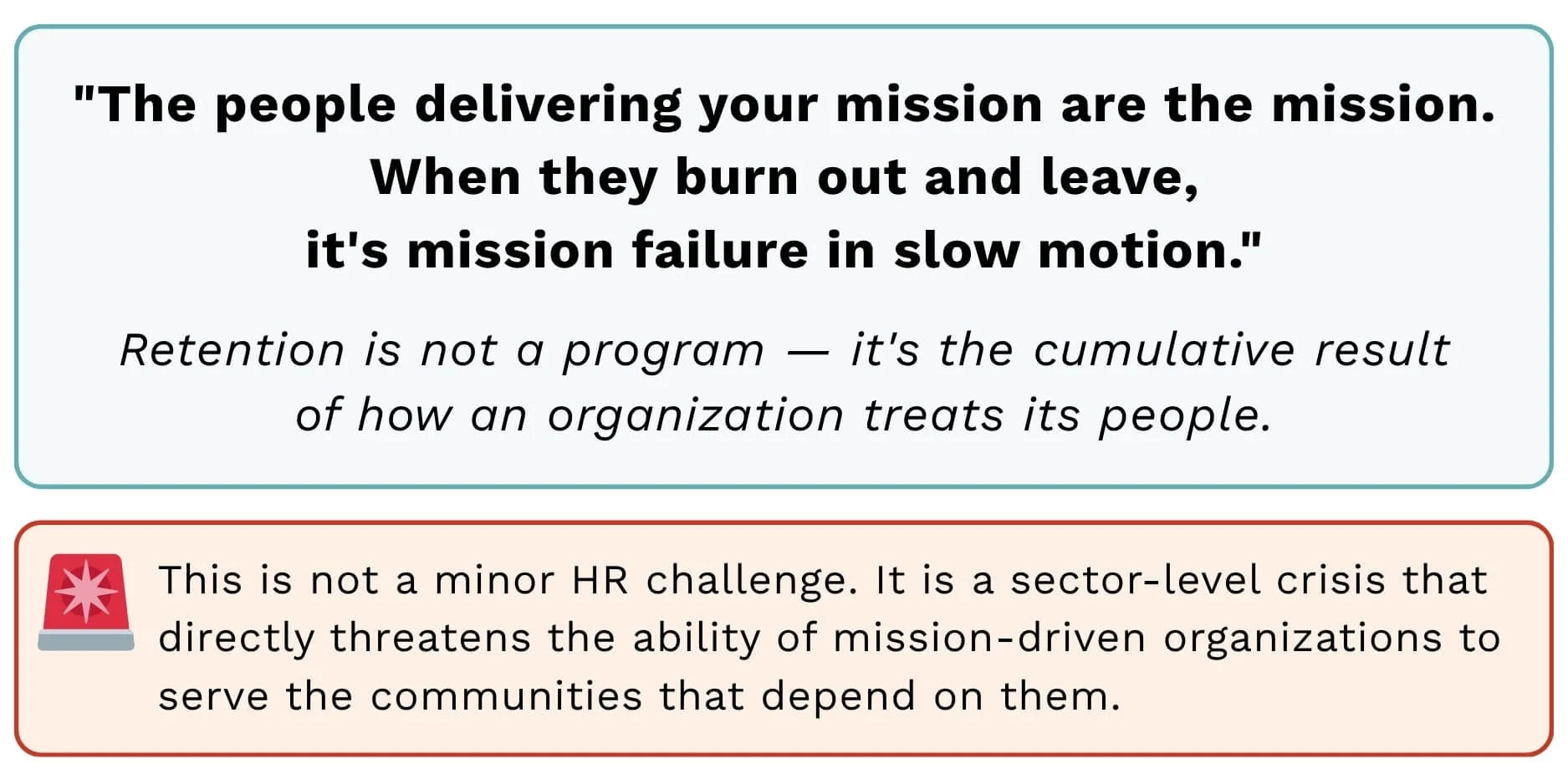
This is not a minor HR challenge. It is a sector-level crisis — one that directly threatens the ability of mission-driven organizations to serve the communities that depend on them.
Understanding Burnout in the Nonprofit Context
Burnout in the nonprofit sector is not the same as burnout elsewhere. Yes, it involves exhaustion, disengagement, and cynicism — the classic symptoms. But it also carries something heavier: the particular weight of caring deeply about work that never feels done, serving populations facing urgent and unrelenting need, and doing all of it with resources that are perpetually insufficient.
Among nonprofit employees planning to leave, 59% cited having too much responsibility and not enough support as a top reason.
That's not a compensation problem or a culture problem in isolation — it's a structural problem.
When organizations are chronically understaffed, every remaining employee absorbs more than they should. When funding is uncertain, anxiety permeates the team. When leadership is in transition, the staff that holds the organization together often does so at significant personal cost.
Nonprofit employees often excel at caring for people and causes they're passionate about — but they may overlook their own wellbeing. And when employees' mental and emotional wellbeing suffers, it impacts every part of their work and life, creating a ripple effect across the communities organizations serve.
This is the cycle that leaders need to interrupt — not with wellness perks alone, but with structural and cultural change that takes the root causes of burnout seriously.
Why Retention Failures Are So Costly
The cost of losing a staff member is almost always underestimated. Replacing an employee can cost between 33% and 200% of their annual salary when you account for recruiting, onboarding, and the time it takes for a new hire to reach full productivity. For a sector that operates on thin margins, that's not a budget line — it's a budget crisis.
But the financial cost is only part of the picture.
When experienced staff leave nonprofits, they take with them institutional knowledge, community relationships, and program expertise that cannot be quickly or easily replaced. As experienced professionals leave, nonprofits are often asked to do more with fewer resources — and the talent losses that result from funding interruptions and burnout can take years to fully recover from.
When people aren't sure whether their organization will be able to sustain operations or programs, they start asking themselves if they'd be better off somewhere more stable — and that uncertainty can push talented people out of the sector entirely.

The organizations that lose the retention battle don't just struggle to replace individuals.
They lose organizational coherence, program quality, and the community trust that was built by the people who left.
What Employees Actually Need
The research is consistent about what drives retention in the nonprofit sector — and it goes well beyond salary.
Meaningful work that is visible and acknowledged.
Purpose-driven work is powerful, but employees need to be able to see the impact of their efforts. Organizations that regularly connect staff to the outcomes of their work — celebrating wins, sharing stories, making the mission tangible — build the kind of engagement that keeps people invested.
Reasonable workloads and realistic expectations.
Chronic overload is one of the most direct drivers of burnout. Limiting caseloads, setting realistic project timelines, and building structural safeguards against overwork are among the most effective prevention strategies available to nonprofit organizations. This requires honest conversations about what is actually achievable with existing capacity — and the discipline to say no to scope creep when the team is already stretched.
Flexibility as a baseline, not a benefit.
Benefits such as mental health support, flexible schedules, and hybrid work arrangements are increasingly seen as baseline expectations — not perks — and they contribute significantly to stronger teams and better retention. Organizations that cling to rigid, in-person-only structures without strong justification are competing with one hand tied behind their back.
Professional development and a path forward.
Employees who see a clear trajectory for their growth within an organization are significantly more likely to stay. This means investing in training, creating mentorship opportunities, and having honest conversations about career development — not just at annual review time, but as an ongoing part of the manager-employee relationship.
Leadership that models what it asks of staff.
Culture flows from the top. When leaders work unsustainable hours, skip their own time off, and treat self-sacrifice as a virtue, they set a standard that spreads throughout the organization. When leaders communicate and model healthy boundaries and self-care, staff follow. The inverse is equally true.
Psychological safety and a transparent culture.
Employees who feel they cannot speak honestly about workload, concerns, or challenges are employees who are already on their way out. Building a culture where feedback is welcomed, problems are named without blame, and staff feel genuinely heard is one of the most durable retention investments an organization can make.
The Role of Nonprofit HR — And Its Limits
HR teams in nonprofit organizations often carry an outsized responsibility for retention — and often without the authority, budget, or organizational support to address its root causes. As one nonprofit HR professional put it, trying to keep talent in a pay structure that will never compete with corporate is sometimes difficult. Despite these hurdles, HR can still be a champion — building purpose in the work, programs, and a transparent, supportive culture to compete with for-profit employers.
But HR cannot fix a retention problem that is rooted in organizational structure, leadership behavior, or compensation strategy. When burnout is widespread, it is almost never a problem with individual employees — it is a signal that something in the way the organization operates needs to change.
HR's role in retention is most powerful when it is supported by:
Leadership that takes staff wellbeing seriously as a strategic priority, not an afterthought
Board investment in compensation that reflects the market realities of today, not a decade ago
Managers who are trained, supported, and held accountable for the experience of their direct reports
Organizational systems — for onboarding, performance management, career development, and feedback — that actually function
Without that foundation, even the best HR team is managing symptoms rather than causes.

Building a Retention-Centered Organization
Retention is not a program. It is not a pizza party, an Employee Appreciation Day, or a wellness app subscription. It is the cumulative result of how an organization treats its people — in the policies it sets, the culture it builds, the leaders it develops, and the investments it makes in the people who make the mission possible.
Organizations that win the retention battle in the nonprofit sector share a few common characteristics.
They are honest about what they can offer and communicate it clearly. They invest in their people's growth, not just their output. They take mental health and workload seriously as organizational issues, not personal ones. They hold leadership accountable for the culture they create. And they treat the question "why do people leave?" with the same seriousness that they treat the question "how do we grow our impact?"
The people delivering your mission are the mission. When they burn out and leave, it is not just an operational inconvenience — it is mission failure in slow motion.
The good news is that the sector knows what works.
The research is clear. The strategies are well documented. What is missing, in many organizations, is the will and the investment to act on what is already known.
At Mission Edge, we help nonprofits build the HR infrastructure, leadership capacity, and people-centered systems that drive retention — from compensation strategy and workforce planning to performance management, staff engagement, and organizational culture. Whether you're navigating a retention crisis or building proactively for the future, we're here to help.

Ready to invest in the people behind your mission?
Contact Mission Edge today to speak with one of our HR and organizational development experts.
Mission Edge is a San Diego-based nonprofit dedicated to strengthening mission-driven organizations through HR, executive search, consulting, and capacity-building services.